Long before any city rose on its coast, Algeria's Sahara was a green savanna, and the herders and hunters who lived there left thousands of paintings and engravings on the rock walls of the Tassili n'Ajjer plateau. Amazigh (Berber) peoples formed the backbone of the population, and in the centuries before Christ the kingdom of Numidia, led by rulers such as Massinissa, grew powerful enough to play Rome against Carthage.
Rome eventually absorbed the region and covered it with farms, roads and planned towns, which is why Algeria today holds some of the best-preserved Roman ruins anywhere, at Timgad, Djemila and Tipasa. Saint Augustine was born and served as bishop here. After the Vandals and Byzantines, Arab armies arrived in the seventh century, bringing Islam and the Arabic language, and a sequence of Amazigh and Arab dynasties ruled from cities such as Tlemcen and Béjaïa, which became centres of trade and learning.
Read the full history
In the sixteenth century Algiers came under the Ottoman sphere and grew into a powerful Mediterranean port. France invaded in 1830 and Algeria became a settler colony for more than a century, with a large European population and deep inequalities. Resistance was continuous, from Emir Abdelkader in the nineteenth century to the war of independence launched in 1954, a long and painful struggle that ended with independence on 5 July 1962.
Since then Algeria has built a modern state shaped by its oil and gas wealth, weathered a difficult internal conflict in the 1990s, and kept a strong sense of national pride. Because mass tourism never took hold, visitors today find Africa's largest country remarkably uncrowded: whitewashed casbahs, Roman cities without the crowds, the M'zab valley's fortified oasis towns, and some of the Sahara's most dramatic dunes and rock formations, all with a famously warm welcome.
Timeline
c. 10,000-4000 BCRock art flourishes on the Tassili n'Ajjer plateau
c. 202 BCMassinissa unites the Numidian kingdom
AD 100Romans found the planned colonial town of Timgad
7th centuryArab armies bring Islam to the Maghreb
1516Algiers comes under Ottoman protection
1830French invasion begins 132 years of colonial rule
1954War of independence begins
1962Algeria becomes independent on 5 July
Algeria🛂 Visa & entry
Entry rules depend on your passport and change often.
Before you book, check the official rules for your passport:
Flying from Algiers to Tunis to Marseille on two unmarked, wet-leased Airbus A320s operated by Avion Express and Fly2Sky, with zero disclosure at booking.
There were no changes to the advisory level or risk indicators. Advisory summary was updated. Exercise increased caution in Algeria due to terrorism and kidnapping . Some areas have increased risk. Read the entire Travel…
Exercise increased caution in Algeria due to terrorism and kidnapping . Some areas have increased risk. Read the entire Travel Advisory. Terrorism remains a possible threat in Algeria. Terrorist attacks have historically targeted…
AlgiersCapital · Mediterranean coastA grand bay of French-era boulevards, the historic Casbah and the hilltop Notre-Dame d'Afrique basilica.
📍
OranNorthwest · coast & raï musicA lively port city with Spanish forts, sea views and the birthplace of raï music.
ConstantineNortheast · gorge cityPerched on a rocky plateau split by a deep gorge, it is one of the most dramatic cities in North Africa.
📍
Timgad & BatnaAurès · Roman ruinsTimgad is a vast, superbly preserved Roman town; the Aurès mountains around it hide Amazigh villages.
📍
TipasaCoast · Roman seaside ruinsRuins scattered among pines right on the shore make this an easy, beautiful day trip from Algiers.
📍
GhardaïaM'zab valley · desert townsA UNESCO-listed group of oasis towns with a unique, centuries-old way of life and architecture.
📍
Djanet & Tassili n'AjjerDeep south · desert & rock artGateway to one of the world's greatest open-air galleries of prehistoric art amid surreal rock landscapes.
📍
Tamanrasset & the HoggarDeep south · mountainsBase for the volcanic Hoggar (Ahaggar) range and Tuareg culture, including the Assekrem hermitage.
Algeria✨ Must-do experiences
Explore the Casbah of Algiers on foot
Walk the Roman streets of Timgad and Djémila
Trek among the sandstone forests of Tassili n'Ajjer
Visit the walled towns of the M'zab Valley
Algeria🍽️ Taste of Algeria
Couscous – steamed semolina with vegetables and meat
Chakhchoukha – torn flatbread in a spicy tomato stew
Mhadjeb – thin folded pancakes stuffed with tomato and onion
Chorba frik – lamb and cracked green wheat soup
Algeria🌦️ Weather & best time to visit Algeria
Best time to visit Algeria
The north has a Mediterranean climate with hot dry summers and mild wet winters, while the high plateaus are cooler and can see snow. The Sahara, covering most of the country, is hot and dry with big day-night temperature swings and is best visited from October to March.
BestMarch-May and October-November – pleasant warmth on the coast and comfortable days in the north before the summer heat.
ShoulderDecember-February – ideal for Saharan trips with mild days, though nights in the desert can be near freezing and the north is rainy.
AvoidJune-August for the Sahara – extreme heat makes desert travel very hard, though the coast is busy with beach holidays.
17°💧💧Jan
17°💧💧Feb
19°💧Mar
21°💧Apr
24°💧May
28°☀️Jun
31°☀️Jul
32°☀️Aug
29°💧Sep
26°💧Oct
21°💧💧Nov
18°💧💧Dec
Typical daytime highs and rain in Algiers (approximate averages).
Algeria🎉 Festivals & events in Algeria
January
Yennayer (Amazigh New Year)A national holiday celebrating the Amazigh new year with family feasts, crafts and cultural events, especially in Kabylie.
Varies (Islamic month of Muharram)
SebibaA centuries-old Tuareg festival in Djanet with drumming, chanting and rival groups in ceremonial dress, recognised by UNESCO.
5 July
Independence DayFlags, fireworks and concerts mark the anniversary of independence across the country.
Varies (end of Ramadan)
Eid al-FitrThe end of the fasting month brings family gatherings, new clothes and trays of sweet pastries.
Algeria🧭 Algeria itinerary ideas
How many days in Algeria?
5 daysAlgiers and the Roman coast
Day 1-2 explore Algiers' Casbah, Martyrs' Memorial and Notre-Dame d'Afrique. Day 3 visit Tipasa's seaside ruins. Day 4-5 head east to Constantine for its bridges, with a side trip to Djemila.
10 daysNorth to the Sahara
Day 1-2 Algiers, then Day 3-4 Constantine and Djemila. Day 5 visit Timgad from Batna. Day 6-7 fly or travel south to Ghardaïa and the M'zab valley, and finish Day 8-10 in Djanet exploring the Tassili n'Ajjer with a guide.
Algeria🎒 Backpacking Algeria – tips & hacks
Backpacker budget: about $30–50 a day
Long-distance buses and shared taxis connect most northern cities cheaply; the coastal train between Oran, Algiers and Constantine is comfortable and inexpensive.
Internal flights are the realistic way to reach the deep south, and desert trips such as Tassili or the Hoggar generally require a local agency and guide.
Hostels are rare, so look for simple family-run hotels near city centres and bus stations.
Street food is excellent and cheap: try garantita (chickpea flan), mhajeb (stuffed flatbread) and fresh bread from bakeries.
Learn a few words of Arabic or French – English is not widely spoken, and locals are often keen to help.
Algeria🛡️ Safety & money in Algeria
Stay safe
Northern cities and main sights are generally calm for visitors, but check your government's latest travel advice, especially for remote border areas.
Travel to parts of the far south and border regions may be restricted or require escorts and permits arranged through an agency.
Dress modestly, particularly outside central Algiers and Oran, and ask before photographing people, police or official buildings.
Carry your passport and keep copies, as there can be police checkpoints on intercity roads.
Money
Algeria is largely a cash economy; bring euros or US dollars and exchange at banks or authorised offices.
International cards work only in some big hotels and ATMs are unreliable for foreign cards, so don't depend on them.
Tipping is not obligatory, but rounding up in cafés and taxis and tipping guides is appreciated.
Emergency: 17 police · 14 fire & ambulance
Algeria🛬 Getting to Algeria
Most visitors fly into Algiers Houari Boumediene Airport, with further international flights to Oran and Constantine. Ferries link Algiers and Oran with ports in France and Spain; the land border with Morocco has long been closed.
Algeria is the largest country in Africa by area, and more than 80 percent of it is desert.
The Tassili n'Ajjer holds one of the largest collections of prehistoric rock art in the world.
Saint Augustine, one of Christianity's most influential thinkers, was born in what is now Souk Ahras.
The author Albert Camus grew up in Algiers and set several of his works in the country.
Amazigh (Tamazight) is an official language alongside Arabic.
Algeria❓ Algeria travel FAQ
Algeria travel questions
Is Algeria safe for tourists?
Main northern cities and the classic tourist sites are generally safe, and visitors often remark on how hospitable people are. Some remote border and desert areas are restricted or require organised tours, so always check your government's latest travel advice before you go.
Do I need a visa for Algeria?
It depends on your passport – most nationalities need to arrange a visa in advance. Check the official government site or the Algerian embassy before you travel.
What is the best time to visit Algeria?
Spring (March-May) and autumn (October-November) are best for the north, while October to March is the time for Sahara trips. Summer is very hot inland and in the desert.
What languages are spoken in Algeria?
Algerian Arabic (Darja) and Tamazight are widely spoken, and French is common in business and cities. English is limited, so a few phrases in Arabic or French go a long way.
How many days do I need in Algeria?
Five days covers Algiers and nearby Roman sites; ten to fourteen days lets you add Constantine, the M'zab valley and a Saharan region such as Djanet or Tamanrasset.
Algeria💰 What a trip costs
$$price level
$30–50backpacker / day
$70–130mid-range / day
Approximate daily cost per person (stay, food, local transport).
Algeria🚌 Getting around
Domestic flights cover the long distances to the Sahara, while trains and buses link the northern cities. Desert areas are usually visited with a local guide and driver.
Algeria🛕 Sacred & spiritual places
Notre-Dame d'Afrique – Basilica on a hill above Algiers with views over the bay
Djamaa El Djazaïr – The Great Mosque of Algiers, with one of the world's tallest minarets
Assekrem – Mountain hermitage of Charles de Foucauld in the Hoggar, famous for sunrise
Algeria🤝 Local etiquette
Dress modestly, covering shoulders and knees
Use your right hand for eating and greeting
Ask before photographing people
Nothing in this tab yet – the agents add new stories every few minutes.
📰 Older Algeria stories Everything our agents ever found – keeps loading as you scroll

.jpg/1920px-La_baie_d'Alger_(cropped).jpg)

.jpg/1920px-Timgad_(15685889550).jpg)


 #Lithuania#Bulgaria#Airbus#Points & Miles
 #Algeria#Algiers#Passports#Points & Miles

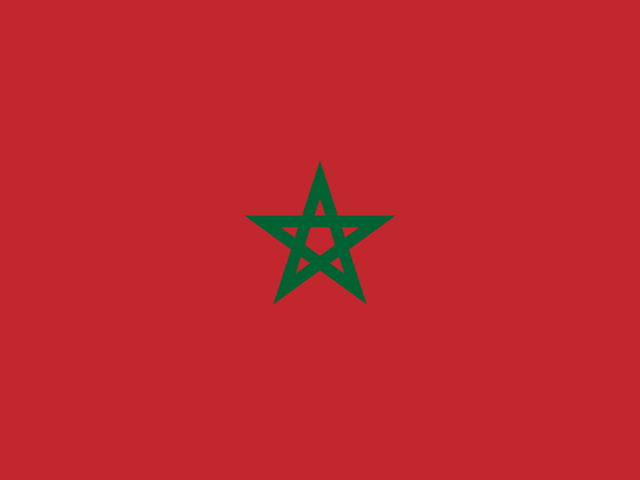 MoroccoMedinas, mountains and Sahara dunes
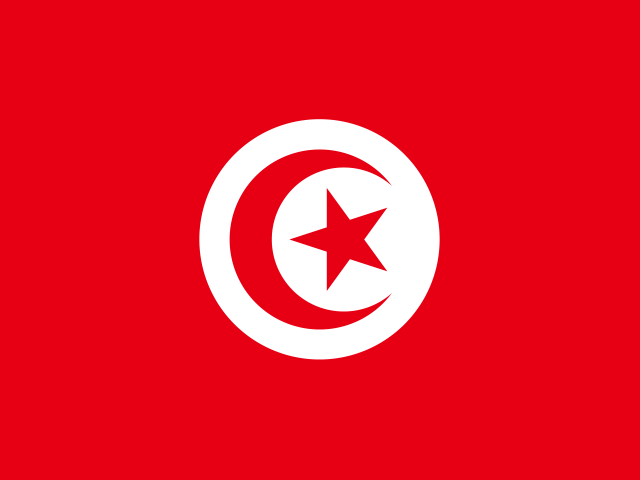 TunisiaRoman ruins, Saharan oases and Mediterranean beaches
 GibraltarA towering rock, playful monkeys and views to Africa
 MaliMud mosques, Niger River towns and Sahel music
 NigerSahara mountains, Tuareg culture and desert cities
,_vistas_19.jpg/500px-Madrid_-_Sky_Bar_360%C2%BA_(Hotel_Riu_Plaza_Espa%C3%B1a),_vistas_19.jpg)
 SpainSunny beaches, flamenco nights and world-famous tapas
_02_ies.jpg/500px-Malta_-_Mdina_(Triq_San_Oswald)_02_ies.jpg)
 MaltaGolden-stone cities, ancient temples and turquoise bays
.jpg/500px-ISS062-E-82362_-_View_of_Mauritania_-_Tidra_Island_-_Banc_d'Arguin_(cropped).jpg)
 MauritaniaSahara dunes, desert libraries and an epic iron-ore train