

_(33383464954).jpg/1920px-Karima_(6)_(33383464954).jpg)


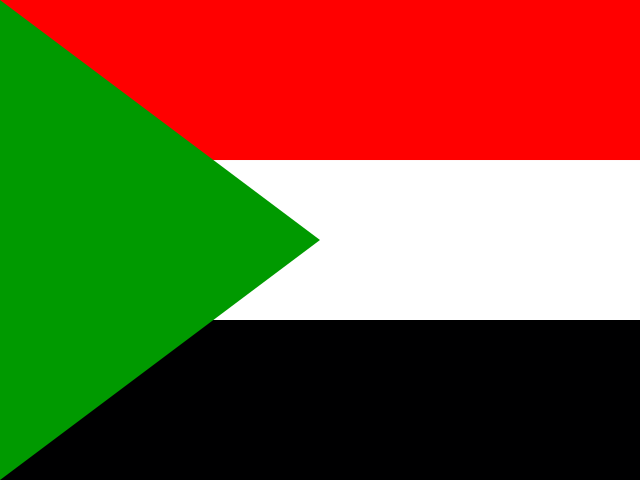
Sudan📸 Photo album · 8 photos · Ultra-HD
Pyramids of Meroë, the Nile and the Red Sea
🕒 –:– local time1 stories this week1 sources 6 top placesCapital Khartoum
Sudan's stretch of the Nile valley was the cradle of some of Africa's oldest and most sophisticated civilisations. The ancient land of Kush, known to the Egyptians as Nubia, produced the kingdom of Kerma, whose capital flourished more than four thousand years ago and whose great mud-brick temples, the deffufa, still stand. Egypt's pharaohs later controlled the region, but around 750 BC Kushite kings from Napata turned the tables and ruled Egypt itself as its Twenty-fifth Dynasty.
The Kushite capital later moved south to Meroë, where a powerful kingdom thrived for centuries, smelting iron and building hundreds of steep-sided pyramids, more than in all of Egypt. From the sixth century Christian Nubian kingdoms such as Makuria and Alodia emerged, decorating their churches with vivid frescoes. Islam spread gradually through trade and migration, and in the sixteenth century the Funj Sultanate of Sennar became the dominant power along the Blue Nile.
In 1821 Ottoman Egypt conquered much of Sudan. Resistance culminated in the Mahdist uprising led by Muhammad Ahmad, the Mahdi, who captured Khartoum in 1885 and established a state with its capital at Omdurman. British and Egyptian forces overthrew the Mahdist state in 1898, creating the Anglo-Egyptian Condominium. Sudan gained independence on 1 January 1956, but the following decades brought civil wars, coups and political upheaval, and South Sudan became a separate country in 2011.
Since 2023 Sudan has been engulfed in a severe armed conflict, and most governments advise against all travel. In more peaceful times, adventurous visitors came for the pyramids of Meroë, the temples of Naqa and Musawwarat, Jebel Barkal and the coral reefs of the Red Sea. These remarkable sites, and Sudan's tradition of generous hospitality, are worth learning about while travel remains unsafe.
Entry rules depend on your passport and change often.
Before you book, check the official rules for your passport:
The latest visa and entry news for Sudan appears below as soon as publishers report it.
On 02/10/2026, a forest fire started in Sudan, until 04/10/2026.
#Sudan#Weather & AlertsSudan has a hot desert climate in the north and a hotter, wetter savannah climate further south. Temperatures regularly exceed 40°C in the hot season. Note that travel is currently advised against due to conflict.
Typical daytime highs and rain in Khartoum (approximate averages).
In peaceful times, this route ran from Khartoum to Meroë's pyramids and the temples of Naqa and Musawwarat. Do not attempt it while travel is advised against – check your government's latest travel advice.
Historically, travellers combined Meroë, Jebel Barkal and Kerma with diving on the Red Sea reefs near Port Sudan. This is for knowledge only until conditions change and official advice allows travel.
Backpacker budget: about $30–50 a day
Emergency: 999
In normal times, Khartoum International Airport and Port Sudan were the main gateways, with overland routes to Egypt. Under current conditions flights and borders are severely disrupted, so check your government's travel advice.
✈️ Cheap flights to Sudan: airports, flight times & best time to fly →
No. Sudan is in a state of armed conflict, and most governments advise against all travel. Check your government's latest travel advice for updates.
Under current conditions, travel to Meroë is not advisable. When peace returns, it is expected to again be one of Africa's most remarkable heritage sites.
In peaceful times, November to February is the most comfortable period. The rest of the year is extremely hot.
It depends on your passport – check the official Sudanese government site or your nearest embassy, and your own government's travel advice, before considering any travel.
Arabic is the main language, and English is also widely understood among educated Sudanese. Many local languages, including Nubian languages, are spoken.
Approximate daily cost per person (stay, food, local transport).
Buses connect the main towns, while desert sites are usually visited by 4x4 with a local driver or tour.
Nothing in this tab yet – the agents add new stories every few minutes.
🌏 You reached the start of our archive.

 South SudanVast wetlands, cattle cultures and the White Nile
 EritreaArt Deco Asmara, Red Sea islands and highland monasteries
 EthiopiaRock-hewn churches, high mountains and the birthplace of coffee
 Central African RepublicDeep rainforest, forest elephants and the Ubangi River
 ChadSahara arches, desert lakes and a reborn wildlife park
 UgandaGorillas, the source of the Nile and lush national parks
 DjiboutiSalt lakes, whale sharks and one of Earth's lowest points

 EgyptPyramids, pharaohs' tombs and Red Sea reefs